Processor Formant Matrix
s3g Processor Formant Matrix 2 is a stereo channel-vocoder and resonant filter-bank audio effect. A live microphone, another audio signal, or the integrated sample-free speech generator supplies the articulation. A procedural carrier follows polyphonic MIDI notes or the estimated pitch of the selected modulator.
The intention is not to mimic an analog vocoder precisely. Formant Matrix is a synthesis instrument that responds to vocal input: speech energy, consonants, pitch, and timing become controls for a procedural carrier and a routable resonant bank.
The 22-by-22 signed routing matrix is the instrument's center. A diagonal patch behaves like a classic matched-band vocoder; shifted, mirrored, sparse, chordal, and custom routes can move one articulation band to another synthesis band without changing the words' timing. Four-pole, eight-pole, and vocal-tract analysis responses trade broad blending for stronger adjacent-formant separation. The Precision transfer path adds speech-focused input conditioning, controlled level stabilization, three-zone consonant reconstruction, and denser carrier excitation without passing the microphone waveform.
ROUTE page combines the signed 22-by-22 map with source and destination meters, per-band trims, modulator selection, envelope behavior, and output.Workflow
- Insert
s3g Processor Formant Matrix 2as a normal stereo CLAP effect. Route a microphone or vocal track toModulator In, then keep the track's host wet/dry control at 100% wet. - Monitor
Formant Matrix Outthrough the track's normal stereo speaker or headphone path. SelectCLASSIC MIC, confirmMOD SOURCEisEXTERNAL MIC, and verify that the orange analysis meters follow the incoming voice. - Hold a MIDI note or chord. The oscillator supplies the carrier; the microphone opens and shapes the filter bank. Silence at the microphone closes the pre-echo bank even while MIDI remains held.
- For keyboard-free use, select
VOICE PITCH, choose a scale and root, then sing. SetPITCH HOLDtoINFINITEwhen the last confident pitch should survive consonants and silence. - Start with
IDENTITYrouting. Change toROTATE,MIRROR,CHORD, orSPARSE, then raiseMATRIX DEPTHgradually. - Choose
CUSTOMfor detailed work. Edit Routing A and B, useMATRIX A / Bto travel between them, and watch the synthesis meters to verify the mapped result. - Use ROUTE to set performance attack/release and voiced/unvoiced behavior, then use BANK to refine analysis response, spectral tuning, and stereo placement. Add carrier movement on SOURCES, text articulation on PHRASE, and post-bank processing on FX only after the words read clearly.
Signal Flow and Roles
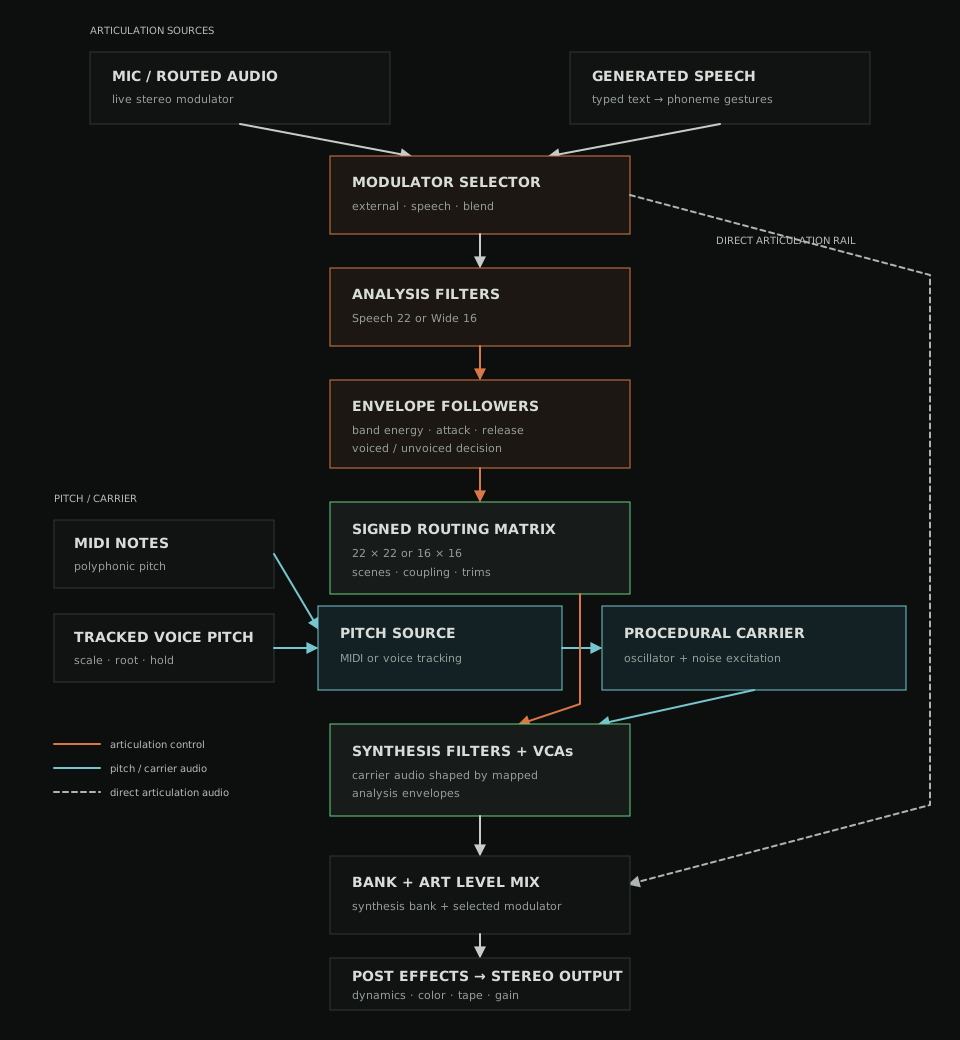
- The selected external mic, generated speech, or blend enters the analysis filters.
- Per-band followers extract articulation energy and the voiced/unvoiced detector selects tonal or noise excitation.
- The signed matrix, coupling, tilt, and trims map analysis channels onto synthesis destinations.
- MIDI notes or tracked voice pitch drive the procedural oscillator carrier through those synthesis filters and VCAs.
- Articulation support, dynamics, octave/fuzz shaping, stereo placement, tape echo, and output gain form the final stereo result.
MOD SOURCE selects EXTERNAL MIC, INTERNAL SPEECH, or BLEND. External Mic never silently falls back to generated speech when its input disappears. Internal Speech compiles typed English into phoneme gestures and measures the procedural result through the same bank. Blend combines both sources before analysis.
MIC GAIN is pre-analysis gain. BANK independently levels the envelope-controlled synthesis bank; it never exposes a raw-carrier bypass. ART independently levels the complete selected modulator. BANK 0% / ART 100% therefore directly auditions Internal Speech, External Mic, or Blend, while BANK 0% / ART 0% is silent. In External Mic mode a hysteretic, click-smoothed presence gate prevents Open Level or a frozen envelope from turning a held carrier into an indefinite drone. Tape echoes already in motion remain free to decay.
The plug-in is advertised as a CLAP audio effect, filter, and stereo processor rather than a CLAP instrument. Its CLAP and MIDI note input remains available, so an effect-classified instance can still play its carrier from a keyboard or routed MIDI track.
Analysis and Synthesis Banks
SPEECH 22 surrounds twenty approximately quarter-octave band-pass channels with low-pass and high-pass endpoints. Its nominal centers are LP 185, 220, 262, 311, 370, 440, 523, 622, 740, 880, 1047, 1245, 1480, 1760, 2093, 2489, 2960, 3520, 4186, 4978, 5920, and HP 7040 Hz. WIDE 16 spreads sixteen active band-pass channels from 90 Hz toward 9 kHz for non-speech and abstract routing. In Wide 16 the ROUTE editor expands to a full-size 16-by-16 grid; meters, trims, labels, keyboard navigation, and scene tools follow those active channels. The six hidden Speech-22 rows and columns remain stored and return unchanged when the larger layout is restored.
ANALYSIS RESPONSE selects 4 POLE, 8 POLE, or MOUTH MODEL. Four Pole gives broad, forgiving channels; Eight Pole gives stronger adjacent-formant separation and is the Classic Mic default. Mouth Model estimates a 16th-order all-pole vocal-tract envelope from a causal 24 ms window every 5 ms, reducing the imprint of the singer's pitch while the fast measured-band path retains fricatives and stops. MOUTH FOCUS balances that LPC tract estimate against the immediate measured bank: raise it for stable, pitch-independent vowels; lower it for more raw pitch imprint and fast-band articulation. Noise confidence still moves consonants toward the fast path at maximum Focus. DEFINITION progressively adds energy-domain detection, local spectral contrast, transient-sensitive consonant tracking, band-local tonal/noise excitation, and carrier-band compensation. These controls insert neither dry microphone audio nor recorded material.
ANALYSIS WIDTH sets detector bandwidth independently of pole count. Narrow values emphasize separation; broad values keep vowels continuous between fixed centers. On-center calibration keeps 4 Pole and 8 Pole comparable in level while their skirt rejection remains different.
Every active analysis channel has an envelope follower. Those 22 signals are internal controls, not CLAP audio, CV, or modulation outputs: the matrix applies them directly to synthesis-band VCAs. IDENTITY matches analysis channel n to synthesis channel n; custom routing can fan one follower into several destinations, collect several followers into one destination, invert contributions, or morph between two maps. This remaps spectral transfer inside the bank. An exposed envelope-follower output would instead let a band control parameters or devices outside this fixed analysis-to-synthesis path.
TRANSFER selects PRECISION or EXPRESSIVE. Precision uses a more literal energy transfer, faster routing control, stronger carrier-band reconstruction, and a linear zero-drive bank. Expressive retains the expanded contrast and saturation used by the earlier creative profiles. Before either analyzer, Low/Mid/Air EQ, Analysis Compression, VOICE FOCUS, and LEVELER condition the detector input. Per-band NOISE REJ learns a slow floor and SPEC BAL reinforces weak valid formants without flattening the word shape. These controls neither change the anti-drone threshold nor create a dry path.
HF DETAIL restores fricative timing above the fixed bank. SYNTHETIC uses only the carrier reconstruction, SWITCHED admits the high-passed residual only for noise-like articulation, and DIRECT keeps it ready whenever a carrier is active. Level and Cutoff set the amount and lower edge. The residual remains carrier- and anti-drone-gated, so it is not microphone monitoring.
MOUTH CIRCUIT is the focused talk-box-style starting point: External Mic articulation, MIDI pitch, a bright saw carrier, Mouth Model analysis, and a custom matrix that morphs from direct articulation to a two-channel formant lift. Hold one MIDI note and exaggerate vowel shapes before adding octave, fuzz, or tape echo.
The generated speech source and carrier have separate pitch roles. Internal Speech uses a fixed neutral excitation frequency for stable analysis; MIDI or Voice Pitch is carried separately to the oscillator bank and exclusively determines the synthesized pitch. The former source Vibrato, Drift, Glide, Scoop, and Decline controls remain state-compatible but are hidden and inert. ART can still expose the neutral-pitch internal voice for direct audition.
Attack and Release set directional envelope timing. Blur smooths changes after detection, while Analysis / Phoneme balances measured energy against phrase-derived targets when Internal Speech contributes. Classic Mic starts Definition at 78%, Precision transfer, moderate Voice Focus and Leveler, and a denser carrier. For a live microphone, shorter Blur, moderate Release, and higher Definition preserve the mouth movement that distinguishes words; long values or low Definition intentionally turn the result toward a smooth vocal-controlled resonator.
BANK MODE offers three relationships:
VOCODERfollows measured band envelopes and ignores Open Level.HYBRIDcan combine measured and score-derived envelopes, using Open Level as a minimum bank opening.FILTER BANKemphasizes the fixed opening while retaining restrained articulation.
The voiced/unvoiced stage can force tonal excitation, force noise, blend both, or detect the appropriate balance. Detect uses measured low/mid periodic energy against upper-band noise, with the speech score only as a bias when generated speech is active. Directional transition controls keep fricatives and stop releases attached to the surrounding vowel instead of sounding like separate percussion.
The consonant reconstructor measures separate low, middle, and upper fricative zones instead of driving one global noise burst. CONS LEVEL sets the reconstruction amount, CONS COLOR moves from periodic buzz toward synthesized hiss, and CONS SPEED controls stop/fricative timing. On SOURCES, DENSITY adds a restrained subharmonic and low-level broadband carrier fill so narrow analysis bands can remain audible even when a simple oscillator has little energy at their centers.
22-by-22 Routing
Matrix columns are analysis sources and rows are synthesis destinations. IDENTITY connects matching channels. ROTATE, MIRROR, CHORD, and SPARSE provide bounded structural maps; MATRIX DEPTH interpolates from identity toward the selected transformation.
CUSTOM stores two complete signed scenes. Every crosspoint ranges from -1 to +1, and destination rows are normalized by total absolute gain. Negative routes invert envelope contribution before the row is bounded. MATRIX A / B morphs continuously between the scenes, while Identity, Copy, Random, and Clear operations establish useful starting structures. BAND COUPLING supplies a quick non-wrapping shift of -3 to +3 bands without rewriting either scene.
The vertical orange meters report the selected modulator's analyzed bands. The horizontal destination meters report the mapped synthesis activity after matrix, coupling, tilt, and per-band trim. Their logarithmic display scaling makes speech-level movement visible without changing the linear DSP data. Band Trim 1–22 scales the corresponding mapped destination from 0 to 200%.
Carrier Pitch, Scales, and Hold
PITCH SOURCE selects polyphonic MIDI or monophonic VOICE PITCH. The tracker estimates approximately 48–2000 Hz from the selected modulator. Its tracking-only conditioning does not remove low or high frequencies from the audible microphone or the analysis bank.
SCALE provides Continuous plus the shared s3g-dsp catalog of 101 musical scales. ROOT transposes the selected collection. The catalog begins with chromatic, major/minor, pentatonic, whole-tone, blues, modal, and bebop families and continues through regional, modern, and limited-transposition collections.
PITCH HOLD bridges unvoiced consonants and temporary detector loss. Values from 20 to 1999 ms time out normally; the maximum position reads INFINITE and retains the last confident pitch until Voice Pitch is disabled or the plug-in is reset. Infinite Hold remembers pitch but does not defeat the External Mic silence gate: the carrier becomes audible again only when new mic articulation opens the bank.
The carrier offers glottal, saw, pulse, folded, and noise shapes. Harmonics, Color, Noise, Pulse Width, and its tempo-syncable triangle/square LFO determine the spectrum presented to the synthesis filters. MIDI remains the correct pitch source for chords and independent note lifetimes.
Matrix-first Profiles
| Profile | Routing behavior |
|---|---|
| CLASSIC MIC | Silence-safe external-mic vocoder with eight-pole Speech 22 analysis, identity routing, no Open floor, and no direct articulation rail. |
| FORMANT GLIDE | Morphs between downward and upward formant translations while retaining neighboring-band speech movement. |
| FIXED CIRCUIT | Collects analysis into stepped three-band blocks; Voice Pitch is chromatic and Pitch Hold is Infinite. |
| GLASS HARMONY | Fans bands into higher and lower destinations with an odd/even stereo pattern. |
| PUBLIC ADDRESS | Concentrates the speech midrange and uses signed adjacent-band cancellation before a compressed, driven output chain. |
| POCKET RADIO | Collects upper speech bands into a moving set of narrow destinations with noise articulation and short echo. |
| LOW PERSONA | Morphs between moderate and deep downward maps. |
| BRIGHT PERSONA | Morphs between upward maps while preserving sibilant destinations. |
| BROKEN RELAY | Crossfades deterministic sparse signed wiring with synchronized carrier motion and multi-head echo. |
| VOCAL ALLOY | Uses MIDI polyphony with diagonal, shifted, mirrored, and signed cross-routes. |
| MOUTH CIRCUIT | Separates mouth shape from source pitch with LPC analysis and a restrained MIDI-carrier formant lift. |
| IMPULSE MATRIX | Turns short external transients into long, high-resonance Wide-16 noise-bank decays. |
| GATED BANK | Uses external program energy as a fast broadband gate around an open, MIDI-pitched pulse filter bank. |
| PULSE BANK | Runs a Wide-16 MIDI pulse carrier with slow pulse-width animation and no external modulator requirement. |
| RHYTHM TRANSFER | Maps the band envelopes of drums or loops onto a bright polyphonic MIDI carrier. |
| SHIFT MORPH | Crossfades Speech-22 scenes offset below and above the diagonal for manual or host-automated formant movement. |
| SPECTRAL DRONE | Holds open a sparse Wide-16 matrix with slow carrier animation, broad stereo placement, and restrained tape echo. |
Impulse Matrix, Gated Bank, Rhythm Transfer, and Shift Morph need external audio plus a held MIDI note. Pulse Bank and Spectral Drone need only MIDI. Profiles are starting points, not hidden algorithms. Editing any matrix cell or structural control changes the profile display to CUSTOM while leaving the complete patch available for state save and host automation.
Editor Pages
ROUTE— matrix scenes, selected crosspoint, meters and trims, topology and layout, Bank Mode, independent BANK and ART levels, Definition, Mouth Focus, performance envelopes, and output. The MIC and INTERNAL SPEECH rails are monitors; their controls live on SOURCES.BANK— Transfer, analysis response and Width, Low/Mid/Air input EQ, Analysis Compression, Voice Focus, Leveler, per-band Noise Reject and Spectral Balance, phoneme blend, resonance, drive, spectral tuning, three-zone consonant controls, HF Detail, stereo behavior, freeze/blur, gesture follow, and voiced/unvoiced transition timing.SOURCES— modulator source and gain, pitch source/root/scale/hold, carrier waveform, color and Density, and carrier LFO.PHRASE— text entry, compiled phoneme score, forced rests, timing, audition, voice, and polyphony.FX— post-bank dynamics, width, octave and fuzz shaping in the left column; the complete multi-head tape echo in the right column. Final Output remains on ROUTE.
Each adjustable parameter has one page owner. Live signal meters may be mirrored on ROUTE for routing feedback, but sliders and menus are not duplicated between pages.
On PHRASE, a vertical bar inserts a rhythmically stable rest: hello | worlds. Repeated bars extend the rest. Text advances one word per MIDI note and wraps after the last word; the pause or scored rest following a word belongs to that note, so holding it never reads into the next word. One-shot and loop-while-held remain available for the non-text phoneme patterns, and timing can be free, note-relative, or transport-synchronized.
The octave layers, fold/fuzz, compression, de-essing, width, and Definition stages process the articulated bank rather than the raw microphone. The tape section supplies three virtual heads, seven combinations, free or synchronized timing, feedback, wear, flutter, tone, and spread. Keep this chain restrained until the analysis meters and identity route already produce intelligible words.
Routing and Project State
- Input: stereo
Modulator In - Output: stereo
Formant Matrix Out - Note input: CLAP notes and MIDI
Project state stores the full signed matrix, both scenes, filter and envelope settings, carrier behavior, phrase text and compiled score, and the post-bank effect chain. The internal speech path is procedural and does not replay recorded voices, grains, impulse responses, or learned reconstruction data.