Listener Mode
Listener Mode lets a plugin analyze its own ambisonic field and use what it hears to influence what happens next. It turns spatial output into an internal score: direction, activity, change, and, where supported, spectral and temporal character can guide later movement, synthesis, or field shaping.
This is a shared design idea rather than one identical circuit copied into every plugin. A room effect may rebalance reflections, a procedural instrument may choose its next region, and a recurrent instrument may return decoded audio to its generating network. The individual plugin page remains the authority for its exact controls and tap point.
Signal Flow
- The plugin forms an internal
ACN/SN3Dambisonic field, usually before finalOUTtrim. - Four tetrahedral or eight cube-corner virtual pickups sample that field in several directions. Some specialized listeners align pickups to a loaded profile or let their directions adapt.
- Each pickup measures recent signal or energy. Extended listeners also derive features such as fast and slow energy, novelty, roughness, spectral balance, habituation, charge, and directional gradients.
- A listening mode decides which directions or pickup relationships matter.
- A response law maps the analysis back to bounded synthesis, movement, register, reflection, or field-shaping controls. Plugins with an explicit
FIELD RETURNmay also run a separate, conditioned audio-return path.
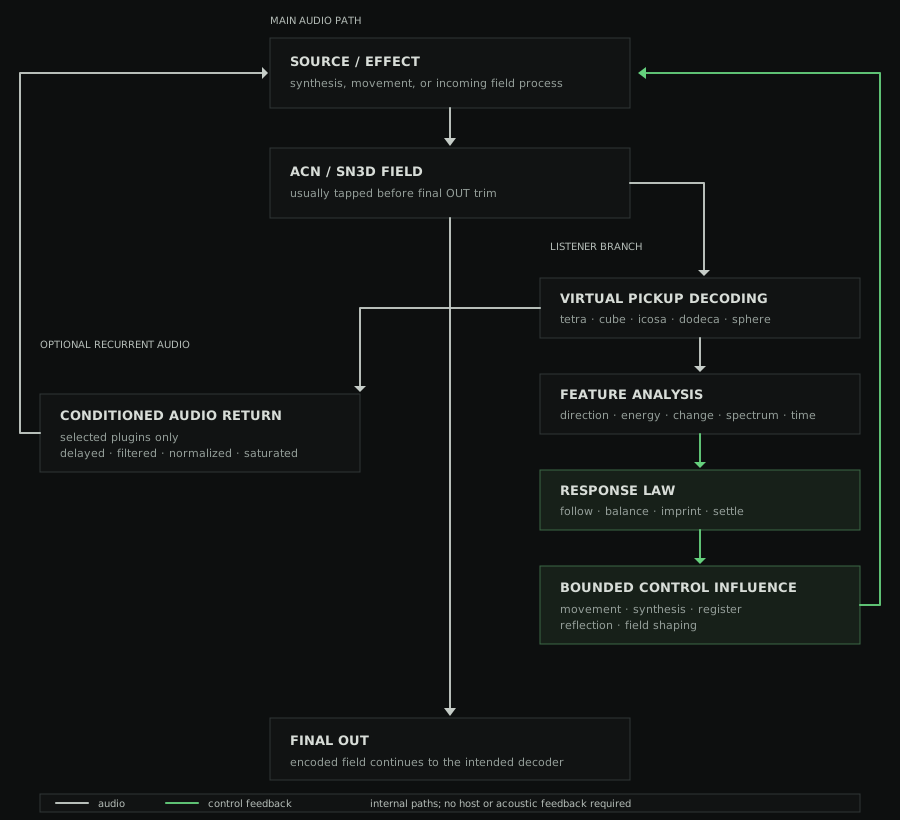
The virtual pickups decode the HOA field mathematically inside the plugin. They do not require a loudspeaker decoder, an extra REAPER track, or monitoring feedback through the host.
The Auditory Body
The common listener uses a symmetric directional body. TETRA 4 provides four broad viewpoints, CUBE 8 adds their opposites, ICOSA 12 provides twelve evenly distributed vertices, DODECA 20 is the twenty-vertex dual of the icosahedron, and SPHERE 24 extends the body for high-order work. Plugins with fixed four- or eight-pickup listeners retain their authored bodies. In AUTO, order-adaptive Ambi Effects use twelve points for 1OA-2OA, twenty for 3OA, and twenty-four for 4OA-7OA. Processor Ambi Imprint instead follows the directions stored in its response profile, while Ambi Encoder Neural Ecology can steer each pickup within a bounded region around its tetrahedral or cubical anchor.
These pickups hear spatial relationships that a mono sum would discard. A source moving between directions changes which pickups become active; width, rotation, environment return, reflections, and ambisonic order may also change the field presented to the listener. Pickup meters are analysis displays, not additional audio outputs.
Shared Control Vocabulary
| Control family | General meaning |
|---|---|
| LISTEN / FIELD LISTEN | Enables the listener or selects its directional law. OFF preserves the plugin's open-loop behavior. |
| FOLLOW | Favors recently active or strongly heard regions. |
| COUNTER | Applies the heard relationship toward the opposing direction. |
| BALANCE | Favors underexposed directions or restrains dominant ones. |
| LOCAL / TRACE | Associates a voice, lobe, or event with its nearest pickup. |
| CROSS | Reads an opposing or cross-connected pickup. |
| DIFFUSE | Uses a stable mixture of the complete pickup body. |
| ROAMING / RING | Moves a read head through the pickup relationships over time. |
| RESPONSE | Chooses what the heard features do. Names such as SETTLE, RESONATE, IMPRINT, ENTRAIN, and WRITE are plugin-specific. |
| AMOUNT / ECOLOGY / CAPTURE / VISCOSITY | Scales the depth of the listener's control influence. The label reflects the synthesis model. |
| FIELD RETURN | Mixes a directional audio return into a generating circuit when that plugin supports one. This is distinct from control feedback. |
| PROPAGATION | Delays and, where documented, filters an audio return to give it temporal distance. |
| RETURN BYPASS | Disables only the audio-return path. Analysis, meters, and control responses may remain active. |
Not every listener exposes every family. In particular, FOLLOW/COUNTER/BALANCE describe a directional preference, while LOCAL/CROSS/DIFFUSE/ROAMING describe how several voices or neural lobes read an auditory body. They solve related but different routing problems.
Response Laws
The response name describes how a plugin interprets the same broad class of evidence:
- Reinforcing responses increase attraction, event activity, resonance, or motion in heard directions. Names include
FOLLOW,CHARGE,CHORUS, andRESONATE. - Balancing responses seek quieter regions or reduce activity where the field remains dominant. Names include
BALANCE,SETTLE, and capture or viscosity controls. - Imprinting responses transfer features of the heard field into newly generated material.
IMPRINT,ENTRAIN, and Wrangler'sWRITEbelong to this family, although each affects very different state. - Legacy or classic responses provide the baseline listener behavior, making them useful references when comparing the alternate response laws.
Response names are not interchangeable presets. For example, Water's IMPRINT affects event material and size, Pulsar's IMPRINT latches features into a new grain, and Wrangler's WRITE can influence a shift-register bit.
Control Feedback and Audio Return
Most s3g Listener Modes are control feedback. The plugin measures its field, then changes bounded control values used to create the next field. Audio samples are not recirculated. Ambi Ray, for example, changes directional reflection gains without changing the authored room geometry, and Wave Terrain changes traversal decisions without feeding decoded audio into its oscillator.
Ambi Encoder Neural Ecology, Ambi Pulsar, and Wrangler can also use an explicit audio return. Those paths are delayed, normalized, filtered, saturated, or otherwise bounded according to the generating circuit. A return bypass therefore does not necessarily turn Listener Mode off; it can leave the auditory analysis and control response running.
Final OUT trim is kept outside the listener loop where a plugin documents pre-output listening. This allows final audition level to change without retuning the ecology. Other exclusions are deliberate: Ray listens to its early and late room response but excludes the direct source, while Bilocation keeps separate listeners for its A and B spaces.
Workflow
- Build or recall a stable patch with listening
OFF, and use that as the open-loop reference. - Follow it with an ambisonic decoder.
- Enable the listener and choose the simplest directional mode that expresses the goal: reinforce with
FOLLOWorLOCAL, oppose withCOUNTERorCROSS, or redistribute withBALANCE. - Raise the listener amount, ecology, capture, or viscosity gradually. The middle of the range usually makes the relationship easier to hear than an immediate maximum setting.
- Where available, compare response laws without changing the underlying patch. Watch the pickup and response meters to distinguish what the field hears from what the synthesis receives.
- Add
FIELD RETURNonly when audio recirculation is part of the intended instrument. UseRETURN BYPASSto compare that deeper loop while retaining the listener's control behavior.
Mode and amount changes are smoothed in the listeners designed for live adjustment. Saved plugin state includes the relevant listener controls; consult the plugin page for its portable preset behavior.
Plugins Using the Concept
| Plugin | What listens | What changes next |
|---|---|---|
| Ambi Effect DJ Filter | Incoming encoded field at an upscaled Icosa12 or Dodeca20 body | Individually filtered, topology-routed, and directionally masked residual re-encoded into that field |
| Ambi Effect Delay | Incoming encoded field at the same order-adaptive body | Per-pickup delayed and feedback-shaped correction, with macro relationships, topology, and directional dry/wet masking |
| Ambi Effect Pitch | Per-pickup field energy and interval/window relationships | Dual-grain pitch correction routed and masked inside the encoded field |
| Ambi Effect Gain | Per-pickup field energy and effective gain relationships | Directional attenuation or boost, topology routing, and optional complementary dry suppression |
| Ambi Effect Resonance Print | Short overlapping spectral observations at each order-adaptive pickup | A saved frequency/amplitude/stability print that the continuing field excites as a topology-routed modal body |
| Ambi Effect Partial Trace | Global spectral peaks reconciled with direction evidence from the order-adaptive pickups | A live or frozen sinusoidal trace with temporal smear, returned through Local, Cross, Diffuse, or Roaming topology |
| Ambi Effect Response Trace | Incoming pickup signals captured and replayed through one directional convolution kernel per pickup | A latency-aligned wet response returned through Local, Cross, Diffuse, or Roaming topology |
| Ambi Encoder Cartography | Stereo material after network delivery, site processing, outdoor propagation, and listener-relative HOA encoding | Bounded per-site process wetness and reach without audio recirculation |
| Processor Ambi Imprint | Re-encoded wet response | Directional response-profile gains |
| Ambi Encoder Ray and Ambi Encoder Ray Bilocation | Early and late room fields | Bounded reflection and late-line balance |
| Ambi Encoder Wave Terrain | Generated pre-output field | Region choice, scan orientation, activity, and traversal weighting |
| Ambi Encoder Water, Ambi Encoder Wind, and Ambi Encoder Insect | Generated field plus encoded environment | Directional motion and response-specific event or material behavior |
| Ambi Encoder Stochastic | Generated pre-output field | Voice-local negative-feedback capture and evolution rates |
| Ambi Encoder Modal | Internal modal HOA field at a fixed selectable Tetra 4 or Cube 8 listener | Direction-aware continuous actuation across four to eight independent resonant bodies |
| Ambi Encoder Wrangler | Completed generated field | Register writing or settling, with optional delayed audio return |
| Ambi Encoder Pulsar | Post-depth point field | Event and grain response ecology, with optional neural return |
| Ambi Encoder Neural Ecology | Live recurrent field | Neural equations, adaptive pickup directions, motion, and lattice decisions |
What Listener Mode Is Not
- Ray listener position:
LISTENER X/Y/Zis a geometric point used to calculate source distance, direction, delay, and reflections.FIELD LISTENis the room's internal directional memory. Ray can use both at once. - A decoder listening mode: Ambi Decoder Head and Ambi Decoder Stereo render an existing field for audition. They do not make the upstream instrument respond to its own output.
- DAW or acoustic feedback: the listener is contained inside the plugin. It does not listen to a microphone, the master output, or sound returning through the room.
- A universal modulation mapping: plugins share an auditory idea and vocabulary, but each maps the evidence into controls appropriate to its own synthesis or processing model.