Ambi Effect Delay
s3g Ambi Effect Delay 64 projects a complete first- through seventh-order ACN/SN3D field onto an Icosa12, Dodeca20, or Sphere24 listener body, then delays each pickup independently. Per-pickup time and feedback trims provide local control, while macro SPRD and DEV create coherent multi-point relationships.
3OA with a SPHERE 24 body, varied delay relationships, and an enabled directional wet mask.Workflow
- Insert the effect after an ambisonic source and match
ORDERto the field. - Follow it with an ambisonic decoder. Additional Ambisonic effects may be placed before the decoder when their supported order and channel count match the field.
- Start with
BODY: AUTO,LOCAL, moderate feedback, and a short enough time to identify the directional repeats. - Raise
SPRDfor an ordered delay fan, then addDEVfor less regular timing. - Use the meters to select active pickups and refine time or feedback on the two rails.
- Introduce
CROSS,DIFFUSE, orROAMINGwithAMTafter the timing relationship is established. - Engage the directional mask when the repeats should occupy one region. Lower
DRYwhen the complementary region should be attenuated rather than merely uneffected.
Signal Flow
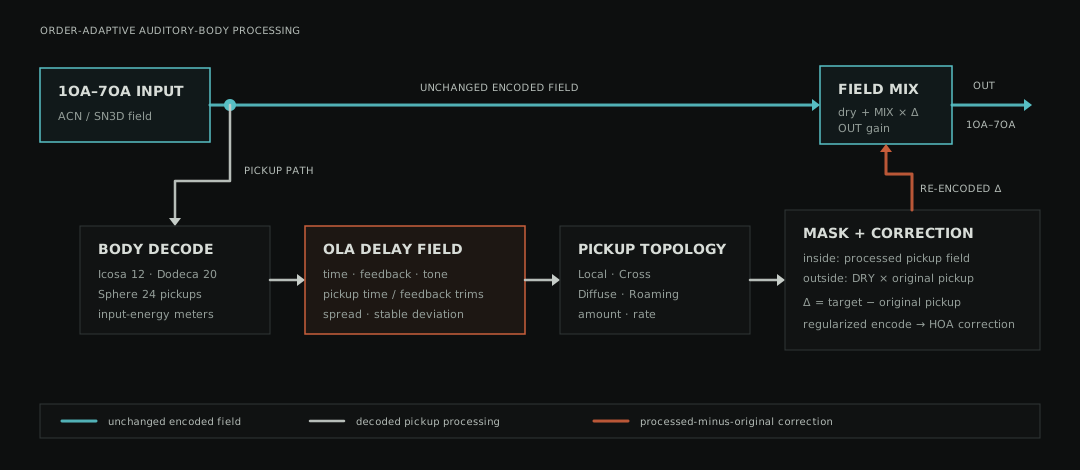
MIX.The delay does not process HOA channels as unrelated lanes. It decodes the selected body, runs one overlap-add fractional delay per pickup, routes the delayed pickup signals through the topology, and re-encodes only the resulting correction. Material outside the pickup subspace therefore remains available on the original-field path.
- The active-order HOA input is copied to the original-field path and decoded at the selected auditory body.
- Independent pickup delays apply effective time, feedback, and feedback tone before topology routing. Time changes hold the existing read tap while a second tap moves, then overlap-add the pair through a complementary 35 ms window.
- The directional mask chooses between the routed delay and the outside-region dry level at each pickup.
- The original pickup signal is subtracted, the correction is re-encoded, and
MIXscales it against the unchanged field beforeOUT.
Order and Auditory Body
| Order | Active channels | AUTO body |
|---|---|---|
| 1OA-2OA | 4-9 | ICOSA 12 |
| 3OA | 16 | DODECA 20 |
| 4OA-7OA | 25-64 | SPHERE 24 |
AUTO selects the body shown above. Every order is deliberately upscaled to at least twelve pickup directions; ICOSA 12, DODECA 20, and SPHERE 24 can also be selected directly. Settings for all twenty-four pickups remain stored and automatable when a smaller body is active.
Controls
| Control | Function |
|---|---|
| ORDER / BODY | Selects the active HOA order and AUTO, ICOSA 12, DODECA 20, or SPHERE 24 pickup body. |
| TIME | Sets the global delay time from 5 to 2000 ms. Automation uses dual-tap overlap-add transitions rather than a continuously moving read head, avoiding zippering and continuous Doppler glide. |
| PICKUP 01-24 TIME TRIM | Offsets one pickup exponentially around the global time, from shorter to longer delays. |
| FEEDBACK | Sets the common repeat level up to 88%. |
| PICKUP 01-24 FEEDBACK TRIM | Adds or subtracts feedback at one pickup, with the result constrained to the stable range. |
| TONE | Moves the feedback-path low-pass from dark repeats toward an open high-frequency response. |
| SPRD | Orders delay time across the active body and applies a smaller complementary feedback relationship. |
| DEV | Adds stable irregular offsets. With spread, deviation, and pickup trims at zero, every point has the same time and feedback. |
| TOPOLOGY / AMT | Routes delayed pickup signals locally, to opposites, through nearest-neighbor diffusion, or around a roaming body path. |
| RATE | Sets the ROAMING traversal rate from 0.005 to 2 Hz. |
| MIX | Scales the re-encoded correction against the unchanged input field. |
| MASK / AZ / EL / WIDTH | Places and shapes the directionally wet delay region. |
| MASK CURVE | Moves from a soft directional falloff through the original response at midpoint to a much tighter effect island at the upper end. |
| DRY | Attenuates the original signal outside the wet region from unity at 0% down to -100% FX ONLY. The negative endpoint leaves only the masked effect island when MIX is fully wet. |
| OUT | Applies final gain from -60 to +12 dB. |
Pickup Editor, Meters, and Camera
Click a numbered pickup, then drag the TIME - / TIME + and FB - / FB + rails below the body. Double-click a rail to reset that value, or double-click a pickup to reset both. The readout reports the selected pickup's effective time and feedback after macro relationships and manual trims.
Every smaller pickup point has a listener-style radial pre-delay energy halo over a -60 dB range. The halo expands and brightens with incoming energy, while the marker ticks show the effective macro relationship after SPRD, DEV, and local trim. The selected point also shows the active Local, Cross, Diffuse, or Roaming hearing route; outline brightness follows directional wet-mask gain.
Use TOP, SIDE, and 3/4 for standard views. Click-drag empty field space to orbit freely. Camera state is saved with the plugin, while pickup and rail gestures remain dedicated to parameter editing.
Directional Dry/Wet Mask
MASK: OFF applies the delay across the whole selected body. Raising it concentrates the processed target around AZ/EL; WIDTH controls its angular footprint while CURVE controls the softness of the boundary. Outside that island, DRY: 0% preserves the original pickup signal and negative values attenuate it until -100% FX ONLY removes it from the body correction subspace. Because MIX blends the correction with the original HOA field, complete outside-region removal requires a fully wet mix.