Ambi Effect DJ Filter
s3g Ambi Effect DJ Filter 64 processes complete first- through seventh-order ACN/SN3D fields. Its global control moves continuously from low-pass filtering on the left, through an open center, to high-pass filtering on the right. Twenty persistent pickup pairs can independently vary filter position and resonance around an Icosa12 or Dodeca20 listener body.
The effect projects the encoded field onto the directional body described in Listener Mode and uses those pickup relationships as an audio-processing topology. Select Icosa12 or Dodeca20 explicitly, or use AUTO to choose a body for the active order.
Workflow
- Place the effect after an ambisonic encoder or encoded-media source and match
ORDERto the incoming field. - Follow it with an ambisonic decoder. Additional Ambisonic effects may be placed before the decoder when their supported order and channel count match the field.
- Start with
BODY: AUTO,TOPOLOGY: LOCAL, and the DJ filter atOPEN. - Sweep left to remove high frequencies or right to remove low frequencies. Add resonance after establishing the useful range.
- Select active pickup points and offset a few toward LP or HP. Their meters make it easier to place stronger variation where the encoded field is actually active.
- Try
CROSSorDIFFUSEwith a moderate amount for spatial redistribution, then useROAMINGwhen the filtering should travel through the field. - Raise
MASK, aim its azimuth/elevation, and adjust width when the effect should occupy one directional region while the rest remains progressively dry. - At high orders, compare
ICOSA 12withDODECA 20. The former is a coarser processing body, not lower-order decoding.
Signal Flow
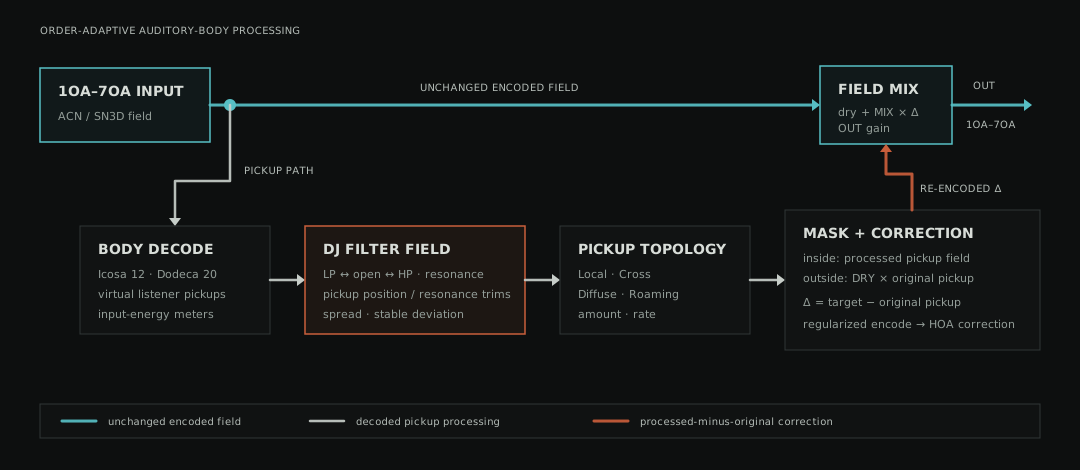
MIX.- The selected active-order field is copied to the dry path and decoded at each virtual pickup in the chosen auditory body.
- Two continuously running filter wings form low-pass and high-pass versions of every pickup signal.
- The global DJ and resonance controls, macro spread/deviation, and each pickup's two bipolar trims determine independent filter settings; the selected topology then relates those filtered signals across the body.
- The original pickup signals are subtracted, leaving only the change made inside the auditory body.
- The optional directional mask interpolates each pickup between processed audio inside the wet region and the selected
DRYlevel outside it. - A regularized encoder returns the masked residual to the active-order field, where
MIXscales it against the unchanged input. OUTapplies final gain and channels above the selected order remain silent.
Re-encoding only the processed-minus-original residual keeps material outside the selected pickup subspace intact. With every pickup trim at zero, the exact center makes filter depth and topology depth zero, so the residual disappears and the active-order field passes unchanged apart from OUT. A nonzero pickup trim deliberately keeps that point active while the global control is centered. Both filter wings remain active so automation passes smoothly through the center.
Order and Auditory Body
| Order | Active channels | AUTO body |
|---|---|---|
| 1OA-3OA | 4-16 | ICOSA 12 |
| 4OA-7OA | 25-64 | DODECA 20 |
AUTO follows the mapping above. You can override it with ICOSA 12 or DODECA 20; every order is deliberately upscaled to one of those bodies. The plugin always exposes 64 input and output pins, while channels above the selected order are inactive.
Controls
| Control | Function |
|---|---|
| ORDER | Selects 1OA through 7OA and therefore 4 through 64 active field channels. |
| BODY | Selects AUTO, ICOSA 12, or DODECA 20. |
| DJ FILTER | Sweeps from maximum low-pass at the left through OPEN at center to maximum high-pass at the right. |
| PICKUP 01-20 FILTER TRIM | Shifts an individual pickup by up to half the complete DJ-filter range toward LP or HP. Inactive pickup settings are retained when the body changes. |
| RESONANCE | Adds emphasis around the moving cutoff. The cascaded state-variable filter keeps a damped second stage for controlled high settings. |
| PICKUP 01-20 RESONANCE TRIM | Offsets resonance independently at each pickup. Inactive settings remain available when returning to the larger body. |
| SPRD | Creates an ordered macro-style relationship across the active pickup body for filter position and resonance. |
| DEV | Adds a stable, irregular per-pickup offset. At SPRD: 0, DEV: 0, and zero pickup trims, all pickups use the same global settings. |
| TOPOLOGY | Chooses how filtered pickup signals are related before residual re-encoding. |
| AMOUNT | Blends from each pickup's own filtered signal toward the chosen topology. Its effective depth follows the DJ filter away from center. |
| ROAM RATE | Sets the traversal rate for ROAMING, from 0.005 to 2 Hz. |
| MIX | Scales the re-encoded residual while preserving the original field. |
| MASK | Blends from the normal all-wet residual at OFF toward a directionally weighted wet region. |
| MASK AZ / EL | Aims the center of the wet region in ambisonic azimuth and elevation. |
| MASK WIDTH | Changes the directional falloff from a concentrated pickup region to a broad spatial wash. |
| MASK CURVE | Changes the falloff shape independently of width. The midpoint preserves the original response; lower values soften the boundary and higher values tighten it toward a sharply isolated effect island. |
| MASK DRY | Attenuates the original signal outside the wet region from unity at 0% down to -100% FX ONLY. The negative endpoint removes the outside-mask dry signal when MIX is fully wet. |
| OUT | Applies final gain from -60 to +12 dB. |
Pickup Editing and Meters
Click a numbered point in the auditory-body display to select it, then drag the LP TRIM / HP TRIM and RES - / RES + rails below the body. Double-click a rail to reset that value; double-click a point to reset both. All 24 pickup parameters are independently automatable, even when the current body activates only four or eight of them.
Each point has a listener-style radial pre-effect energy halo over a -60 dB display range. The halo expands and brightens with incoming energy, making the spatial distribution across the body readable at a glance before filtering, topology, or masking. The marker below each point shows filter trim, and the marker at its left shows resonance trim. The point outline represents its current wet-mask gain.
Use TOP, SIDE, and 3/4 in the field header for standard camera views. Click-drag empty space in the field to orbit freely; pickup clicks and trim-rail drags remain editing gestures.
Directional Wet Mask
The mask is applied after filtering and topology but before correction re-encoding. MASK: OFF preserves the normal all-wet behavior. Raising MASK makes the region nearest AZ/EL retain more of the effect while other pickups approach DRY. At DRY: 0%, the outside region remains the original field. Moving through the negative range attenuates that background; DRY: -100% FX ONLY removes it from the pickup correction subspace when MIX is fully wet. Lower MIX values intentionally blend the unchanged HOA input back in.
The dashed aim circle in the body display shows the mask center and approximate width; its line weight increases with CURVE. The mask follows the selected Icosa or Dodeca body, and its pickup gains are smoothed during automation. At the tight endpoint the falloff exponent is eight times the midpoint value, allowing substantially stronger rejection of pickups outside the aimed region.
Topology Modes
- LOCAL returns each filtered pickup to its own directional anchor.
- CROSS sends each filtered pickup to the opposing anchor.
- DIFFUSE replaces each pickup with the average of its nearest neighbors on the selected body.
- ROAMING continuously moves pickup signals around a connected path over the body.
ROAM RATEcontrols one complete traversal.
Topology is deliberately coupled to each pickup's filter depth. A pickup at its effective OPEN position receives no topology correction; with every trim at zero, the global center remains a reliable neutral point during one-knob performance sweeps.